
On the surface, that sounds like a small administrative change. But anyone who has worked in residential solar knows that permitting and inspection delays can become a surprisingly large part of the customer experience.
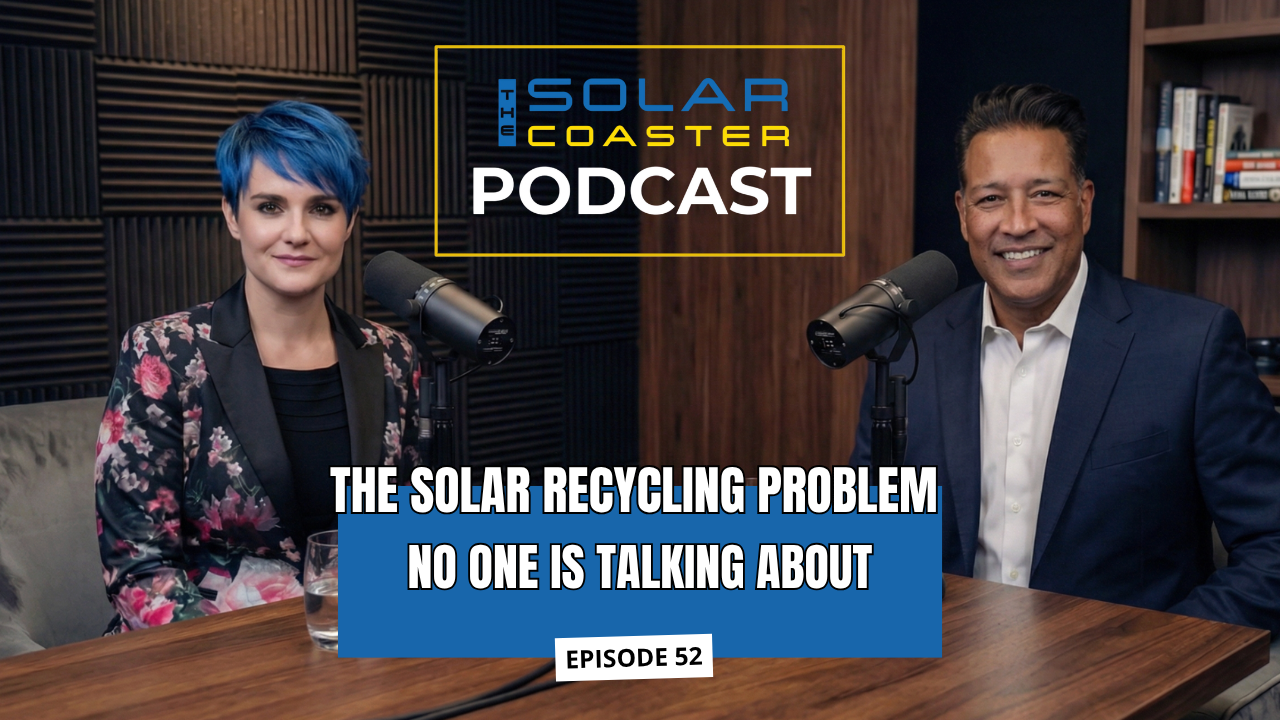
In Episode 54 of The Solar Coaster, Anna Covert and Alex Herrera examine the bigger question behind California’s proposal: Can the state modernize one of solar’s most frustrating bottlenecks without weakening the safety standards homeowners depend on?
The Solar Industry Has a Process Problem
Residential solar is often discussed as a technology business.
But installing solar is only one part of the process.
A project also moves through design, permitting, financing, equipment procurement, construction, utility interconnection, inspection, and permission to operate. Any one of those stages can slow a project down.
That is why seemingly minor policy changes can matter so much.
The solar industry has already seen how dramatically state policy can influence the residential market. Our conversation with California solar policy advocate Bernadette Del Chiaro explored exactly how rules surrounding rooftop solar, net metering, and distributed generation can reshape an entire market. You can read more in our in-depth discussion of California rooftop solar policy or watch Episode 22 of The Solar Coaster.
AB 1738 addresses a different piece of the system, but the underlying theme is similar: policy determines how easy or difficult it is for homeowners to actually adopt clean-energy technology.
Why Remote Inspections Are Appealing
The argument for remote inspections is relatively straightforward.
If an inspector can review a standardized installation using photos, documentation, recorded video, or a live video walkthrough, there may be no reason to make the contractor wait several hours for someone to physically drive to the property.
That could create benefits for everyone involved.
Local governments could use inspectors more efficiently. Contractors could spend less time waiting at completed jobs. Homeowners could potentially move from installation to final approval faster.
And for jurisdictions with staffing shortages or large service territories, remote review could help departments process more projects without immediately increasing staffing.
Those efficiencies matter because solar adoption is affected by much more than hardware cost.
Permitting, inspections, utility requirements, administrative overhead, customer acquisition, and financing are all part of what the industry commonly calls solar’s soft costs.
Reducing those costs and delays can make the entire customer journey easier.
Solar + Battery Makes the Safety Question More Important
The strongest argument against expanding remote inspections is also easy to understand.
Solar panels and home batteries are not cosmetic improvements.
They interact with a home’s electrical system. Battery systems may involve additional equipment, clearances, disconnects, wiring, labeling, ventilation, and fire-safety considerations.
As batteries become an increasingly important part of residential energy strategy, those questions become even more relevant.
We have explored that shift in several recent Solar Coaster discussions because the modern residential system is becoming less about solar panels alone and more about solar + storage + energy management.
That means an inspection needs to do more than simply confirm that equipment exists.
It needs to provide confidence that the installation was completed properly.
A Photo Cannot Always Tell the Whole Story
This is where the episode becomes a real debate rather than a simple endorsement of modernization.
A photograph can show one angle while hiding another.
A video walkthrough can document equipment but still miss something an experienced inspector might notice while physically standing at the property.
Clearances, wiring routes, labeling, structural conditions, equipment access, and the relationship between different components can sometimes be easier to evaluate in person.
That does not mean remote inspections are inherently unsafe.
It means they probably should not be treated as a universal replacement for physical inspections.
The Better Model May Be Inspection Triage
The most compelling version of remote inspection may be a hybrid model.
Standardized, straightforward projects could move through remote review.
More complicated projects, unusual installations, or inspections where documentation raises a question could automatically be escalated to an on-site visit.
Think of it less as eliminating inspectors and more as allowing inspectors to spend their time where their physical presence adds the most value.
That distinction is important.
Solar does not need less accountability. It needs more efficient accountability.
Consistency May Matter as Much as Speed
Contractors do not only struggle with slow processes.
They struggle with unpredictable ones.
A company operating across several jurisdictions can encounter completely different permitting and inspection requirements from one city to the next.
One building department may accept a certain set of photographs. Another may require a live walkthrough. Another may insist on an in-person visit regardless of project complexity.
That inconsistency creates additional administrative work and makes project timelines harder to predict.
For homeowners, it can make solar feel unnecessarily complicated.
This is part of a larger challenge we have repeatedly explored throughout The Solar Coaster: the technology may be ready, but the systems surrounding the technology often struggle to keep pace.
Implementation Will Determine Whether This Works
Passing legislation is only the beginning.
Local governments need procedures, software, staff training, documentation standards, and clear escalation rules.
A functioning remote inspection program needs to answer practical questions:
- What photographs or video are required?
- Who is permitted to submit the documentation?
- Does an inspector need to participate live?
- How are records stored?
- What happens when the evidence is incomplete?
- When does a remote inspection become an on-site inspection?
- Who is ultimately responsible for the approval?
Those details are less exciting than the headline, but they are ultimately what will determine whether the policy makes projects easier or simply creates another layer of uncertainty.
Trust Matters Too
There is also a customer-perception issue.
Homeowners generally understand why an inspector physically visiting their property represents oversight.
A remote process may require more explanation.
If consumers believe a video inspection is simply a shortcut designed to push more installations through the system, confidence could suffer.
That would be particularly damaging in an industry that is already dealing with customer trust issues.
We discussed the consequences of that trust gap in our conversation about the growing number of homeowners left behind when installers or manufacturers disappear. Read more in Episode 15 with Brian Kelly, where we examine the service and warranty challenges facing “orphaned” solar homeowners.
Remote inspections therefore need to be positioned as a different method of oversight—not less oversight.
Remote Inspections Will Not Fix Everything
It is equally important not to exaggerate what AB 1738 could accomplish.
Inspection delays are only one barrier affecting residential electrification.
Equipment prices, interest rates, utility interconnection, labor availability, permitting requirements, consumer awareness, and financing all affect whether projects move forward.
Remote inspection is therefore better understood as a facilitation policy rather than a transformation policy.
It removes friction from one part of the process.
But small improvements can still matter when they occur thousands of times across an industry.
Small Bottlenecks Can Have Big Effects
This may be the most important lesson from the proposal.
The clean-energy transition does not move forward through one dramatic change.
It moves through hundreds of smaller improvements.
A faster permit.
A clearer interconnection process.
A better financing option.
A simpler battery approval.
A shorter inspection window.
Each improvement removes a little friction from the customer experience.
And when those improvements are repeated across thousands of homes, the effect can become meaningful.
Can Government Become Faster Without Becoming Less Careful?
That is ultimately what makes California AB 1738 more interesting than the words “remote inspection” suggest.
The bill represents a larger question confronting the energy industry and government agencies everywhere:
How much of permitting, inspection, and compliance can become digital without losing accountability?
Consumers want government to move faster.
They also expect government to protect them.
Those goals do not necessarily have to conflict.
A well-designed remote inspection process could allow routine installations to move through the system faster while reserving physical inspections for projects that genuinely require them.
The Solar Coaster Takeaway
Our view is cautiously optimistic.
Remote inspection for residential solar, batteries, heat pumps, and other standardized home-energy technologies makes sense if California maintains strong standards and provides inspectors with the authority to require an on-site review whenever necessary.
The goal should not be to eliminate physical inspection.
The goal should be to eliminate unnecessary waiting.
If California can modernize the inspection process while preserving consumer protection and code compliance, AB 1738 could become one of those unglamorous reforms that quietly makes clean-energy adoption easier.
And sometimes, those are the reforms that matter most.
Explore more conversations about solar policy, technology, storage, and the changing clean-energy market at SolarCoasterBook.com.
Full Podcast Transcript:
Episode 54 Transcript: California Wants to Take Solar Inspections Remote
In this episode of The Solar Coaster, Anna Covert and Alex Herrera discuss California's move toward remote inspections for residential solar, battery storage, heat pumps, and other home-energy equipment—and whether faster approvals can be achieved without compromising safety and accountability.
Anna Covert: Today we’re looking at a California bill that, according to the headline, would enable remote inspection for residential solar batteries, heat pumps, and related home energy equipment. Even with just that framing, the policy idea is easy to understand: make it simpler and faster to verify installations without always sending someone physically to the site. That sounds like a small administrative change, but in practice it could affect how quickly homeowners get projects approved, how much contractors spend waiting around, and how easily cleaner technologies spread. The big question is whether remote inspection is a smart modernization or a shortcut that risks safety and quality.
Alex Herrera: And I think that tension is exactly why this topic is interesting. On one side, if you are a homeowner who has already invested in a solar battery or a heat pump, the last thing you want is a long delay just because a local office is backlogged. On the other side, when we talk about electrical and mechanical systems in homes, people naturally want confidence that the work was done correctly. So the headline raises a very basic policy tradeoff: convenience and speed versus the reassurance that comes from an in-person inspection. The hard part is that both sides have a valid argument.
Anna Covert: Let’s start with the upside. Remote inspection could reduce friction in a system that often slows down even good projects. If an inspector can review photos, video, documents, and maybe live walkthroughs instead of driving across town, that could save time for local governments and for installers. It might also help in areas where staffing is thin or schedules are overloaded. And from a climate perspective, anything that reduces the soft costs and delays around home electrification could make it easier for more people to adopt clean technologies. That is not a trivial benefit.
Alex Herrera: Right, and there’s also a fairness argument. Not every household or contractor experiences permitting the same way. In some places, the process is smooth and fast. In others, it can feel like every minor step adds another week. Remote inspection could make the process more consistent if it is designed well. A homeowner with a straightforward installation should not necessarily have to wait because the system is optimized for the most complicated case. So in theory, this kind of policy can improve throughput without lowering standards, which is why many people in the industry would probably welcome it.
Anna Covert: But the phrase “if it is designed well” is doing a lot of work there. My concern is that remote inspection can create a false sense of completeness. A photo can show one angle and not another. A video call can miss subtle details. Some issues only become obvious when an inspector is on-site and can physically check clearances, wiring paths, labeling, access, or how equipment interacts with the rest of the home. If the bill’s promise is simply to replace physical inspection with digital review in every case, that would raise real questions about whether the inspection is still doing its job.
Alex Herrera: That’s fair, but I would push back on the assumption that remote means sloppy. Plenty of systems use remote verification successfully when the scope is narrow and the checklist is precise. If the installation type is standardized enough, remote review may catch what matters most. The key is not to imagine remote inspection as a one-size-fits-all replacement. It could be a triage tool: simple jobs get remote review, complex or unusual ones still get an on-site visit. In that model, the policy could preserve safety while reserving human time for the cases that really need it.
Anna Covert: That triage idea is probably the most defensible version of the concept. But it depends on rules that are clear enough to be used consistently. Otherwise, you get confusion: one jurisdiction approves remotely, another refuses, one inspector wants a live walkthrough, another wants twelve photos from twelve angles. Contractors hate unpredictability, and homeowners hate it too. If California is trying to make home electrification easier, then consistency across local offices could matter as much as the inspection method itself. A policy can look progressive on paper and still frustrate everyone if implementation is uneven.
Alex Herrera: And implementation is where the real debate usually lives. Remote inspection sounds modern, but local governments need tools, training, and procedures to support it. There have to be standards for what counts as enough evidence, how records are stored, who signs off, and what happens if a problem is discovered later. A lot of policy conversations skip over that part and focus on the headline win. But if you are responsible for code compliance, the details are the whole game. The success of the bill would depend less on the idea than on the workflow behind it.
Anna Covert: Another issue is trust. A homeowner may trust a brand-name installer or a city inspector, but maybe not the idea of a remote process they cannot see. People often like oversight when it feels personal and dislike it when it feels automated. So even if remote inspection is safe and efficient, officials will probably need to explain it carefully. They would need to show that the process still protects consumers, not just speeds up approvals. Otherwise critics might frame it as lowering the bar for the sake of growth.
Alex Herrera: I think that’s where the public-interest case becomes important. If the bill helps approved systems come online faster, that can support energy savings, backup power, and electrification in homes. Solar batteries can help households manage outages or shift energy use. Heat pumps can replace older heating and cooling systems with something more efficient. Those are meaningful benefits, even if the policy is only about inspections. So from a broader view, this is not just an administrative tweak. It can influence whether clean home technologies feel accessible or burdensome.
Anna Covert: Still, we should be careful not to overstate the impact. A remote inspection policy by itself does not guarantee more installations, lower prices, or better outcomes. It removes one bottleneck, which may or may not be the main one. Labor shortages, equipment costs, utility interconnection, financing, and consumer awareness all matter too. That is why I would call this a facilitation policy rather than a transformation policy. It can help at the margins, and margins matter, but it is not a complete solution to the challenges of residential electrification.
Alex Herrera: Agreed, though margins can be bigger than they look. When a process is repeatedly painful, even a modest improvement can change behavior. If contractors know they can get faster approval, they may bid more jobs. If homeowners hear that the inspection step will not stall the project for weeks, they may be more willing to sign a contract. Policy often works through these confidence effects. It is not only the technical speed of the process; it is the perception that the system is usable. A more usable system can unlock demand.
Anna Covert: Let me press on the safety side one more time, though, because that is the strongest counterargument. Residential solar batteries and heat pumps involve equipment that interacts with electrical systems, building structure, and in some cases fire safety considerations. The public expects that there is a qualified person verifying that installations meet code. If remote inspection becomes the default without enough guardrails, any serious incident could quickly erode trust in the entire approach. So the safest political route would be to make remote inspection obviously limited, transparent, and reversible when needed.
Alex Herrera: That’s a good point, and it suggests the policy should probably be judged by its safeguards, not just its ambition. For example, remote inspection could require submitted evidence from certified installers, standardized checklists, clear documentation, and an easy path to escalate to an on-site inspection if anything is uncertain. That would make the process more like a controlled filter than a blind substitute. In that sense, the bill could be less about taking inspectors out of the picture and more about using their time more strategically.
Anna Covert: And if we look at the politics of it, this kind of bill can appeal to different groups for different reasons. Industry likes efficiency. Homeowners like speed. Local agencies may like the possibility of handling more cases with limited staff. Environmental advocates may like anything that smooths the path for cleaner home energy systems. The challenge is that all those groups can still disagree on how much oversight is enough. So even when there is broad support for the goal, there can be intense debate over the mechanism.
Alex Herrera: That is why I think remote inspection policies often become test cases for a larger question: how much of permitting and compliance can be digitized without losing accountability? We see that question everywhere now. People want government to be faster, but they also want government to be careful. California, based on the headline here, seems to be moving toward a model that tries to do both. Whether that model works will depend on execution, not slogans. If it is thoughtful, it could be a useful template. If it is rushed, it could become a cautionary tale.
Anna Covert: So my bottom line is cautious optimism. The idea of remote inspection for residential solar batteries, heat pumps, and similar systems makes sense as a way to reduce delays and improve access, but only if the state keeps strong standards and uses remote review selectively. I would not want to hear that physical inspection is being abandoned across the board. I would want to hear that California is modernizing a bottleneck without weakening the underlying code enforcement structure. That distinction matters a lot, even if it sounds bureaucratic.
Alex Herrera: And my bottom line is a little more enthusiastic, but still conditional. I think this kind of policy could be a practical step toward making home clean-energy upgrades less cumbersome. The headline suggests a move toward flexibility, and flexibility is often what these systems need. But the real test will be whether the process remains trustworthy, consistent, and easy to understand. If it does, then remote inspection could be one of those unglamorous reforms that quietly makes a big difference.