
Three Visionaries, One Energy Future: Our Climate Week Special Series Recap
What will it take to power the next generation of technology, modernize America’s electric grid and create a more sustainable future for our planet?
For our Climate Week Special Series on The Solar Coaster Podcast, I had the opportunity to explore these questions with three remarkable guests: Dr. Alexander “Sandy” MacDonald, Chip Comins and Henk Rogers.
Each brought a different perspective. Sandy shared his vision for a nationwide electricity network. Chip explored the infrastructure demands of artificial intelligence and the importance of connecting people around large-scale energy projects. Henk took us from Hawaii’s renewable energy movement to emerging battery technology, global sustainability and even life beyond Earth.
Although their experiences are very different, the conversations revealed a common challenge: we have extraordinary technological capabilities, but realizing their potential requires infrastructure, investment, cooperation and action.
Watch Our Climate Week Special Series
Explore all three interviews on The Solar Coaster YouTube channel, or continue reading for highlights from each conversation.
Dr. Alexander “Sandy” MacDonald: Building America’s Energy Future
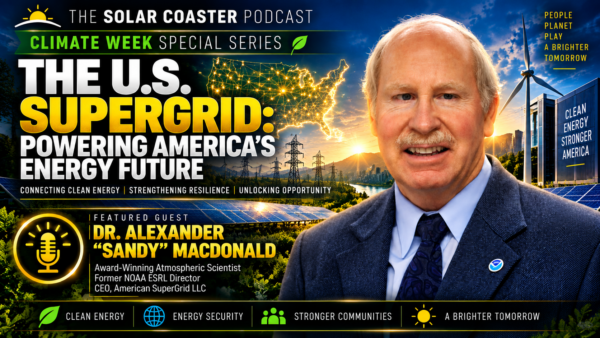
The U.S. SuperGrid: Powering America’s Energy Future
Our Climate Week series begins with a big infrastructure question: what if America could move electricity across the country through a national network, much like our interstate highway system moves people and goods?
Dr. Alexander “Sandy” MacDonald, a former NOAA laboratory director, atmospheric scientist and inventor of Science On a Sphere, joined me to explain his proposal for a nationwide high-voltage direct current (HVDC) SuperGrid.
His vision involves a network of long-distance transmission lines that could connect renewable energy resources with population centers and major electricity markets. One proposed approach would use underground transmission along existing interstate highway corridors, with connections to the regional electric grids already serving homes and businesses.
Three Takeaways From Sandy
America’s energy resources and electricity demand are not always in the same place. Sandy explained how regions with substantial wind and solar potential, including the Great Plains, could potentially serve electricity customers across a much wider geographic area if transmission capacity were available.
Resilience must be part of infrastructure planning. We discussed hurricanes, ice storms, cybersecurity and severe solar weather. Sandy’s proposal includes underground transmission and multiple pathways for moving electricity, although local grid resilience would still require its own investment.
Major infrastructure projects require long-term thinking. Sandy compared the opportunity to earlier generations’ investments in railroads and interstate highways. His proposal raises significant questions about construction, financing and regulation, but it also encourages us to consider what electricity infrastructure future generations will need.
From our conversation: Sandy’s interstate highway analogy helped make a complicated idea easier to understand. We have developed a national transportation system to move goods efficiently. His question is whether we can create a comparable long-distance network for electricity.
The SuperGrid is a proposal, not an approved nationwide construction project. Our discussion explores both its potential and the work that would be required to turn it into reality.
Explore Sandy’s work:
Dr. Sandy MacDonald on LinkedIn
American Energy Initiative
NOAA Science On a Sphere
Watch the interview: The U.S. SuperGrid: Powering America’s Energy Future
Chip Comins: Can America Power the AI Revolution?
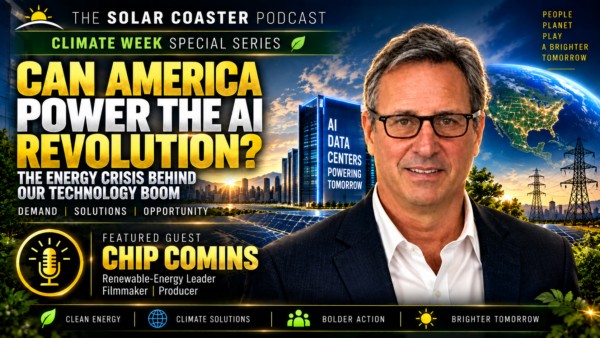
The Energy Crisis Behind Our Technology Boom
Artificial intelligence is advancing rapidly, but every AI application depends on physical infrastructure. Behind the software are data centers, servers, cooling systems and a growing need for reliable electricity.
My conversation with Chip Comins, founder of AREDAY and Chairman and CEO of the American Renewable Energy Institute, explored the relationship between technological growth and America’s energy infrastructure.
Chip is also involved in the proposed HVDC SuperGrid initiative, connecting this interview directly to our conversation with Sandy MacDonald.
Three Takeaways From Chip
The AI revolution has a physical footprint. Chip and I discussed the electricity and water requirements associated with expanding data center infrastructure. As demand grows, utilities, developers and communities will need to consider where facilities are built and how they are supplied.
Transmission could influence where renewable energy projects are developed. A more interconnected electricity network could potentially provide solar and wind developers with access to additional markets. Chip discussed an underground HVDC network that would complement existing utilities rather than replace them.
Technology alone does not create change. Chip has spent decades bringing together scientists, business leaders, policymakers and environmental advocates through AREDAY. We discussed why major energy projects require cooperation among organizations that may have very different priorities.
From our conversation: We often talk about AI as a digital revolution. Chip brought the discussion back to the electricity, cooling, transmission and investment required to make that revolution possible.
Why Storytelling Matters
One of my favorite parts of this interview was our discussion about Chip’s filmmaking background, including his involvement with Racing Extinction.
Energy infrastructure can be difficult to explain. Technical reports are important, but film, art and public events can help audiences understand why these issues matter to their communities and their future.
That connection between technology and communication is particularly meaningful to me. As we work to develop cleaner energy systems, we also need to make the opportunities, costs and challenges understandable to the people affected by them.
Explore Chip’s work:
Chip Comins on LinkedIn
AREDAY
American Energy Initiative
HVDC SuperGrid
Watch the interview: Can America Power the AI Revolution?
Henk Rogers: A Sustainable Future on Earth and Beyond
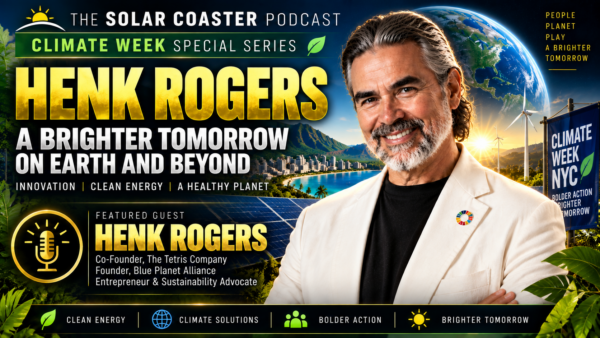
Beyond Tetris
Our final Climate Week conversation took us in a completely different direction.
Most people recognize Henk Rogers as the entrepreneur who helped bring Tetris to the world. But after a life-changing medical emergency in 2005, he began searching for a new purpose.
That journey led him to renewable energy, battery technology, environmental advocacy, entrepreneurship and space exploration.
Henk founded Blue Planet Foundation, which helped advance Hawaii’s movement toward 100% renewable electricity by 2045. He also founded Blue Planet Energy and Blue Planet Alliance, extending his work from local energy projects to international collaboration.
Three Takeaways From Henk
Meaningful change starts with action. Henk described how Blue Planet Foundation shifted from raising awareness to pursuing legislation and community engagement. Children became an important part of the movement, participating in light bulb exchanges and sharing their hopes for the future with lawmakers.
Energy storage is essential to a renewable future. We discussed Henk’s work with sodium-based batteries and supercapacitors, along with hydrogen production and virtual power plants. Each technology addresses a different challenge, from managing short peaks in demand to storing energy for later use.
Lessons from space can improve life on Earth. Henk discussed HI-SEAS, the Hawaii-based facility used to simulate aspects of living on Mars. Surviving in an environment with limited resources requires conservation, reuse and self-sufficiency. He believes those same principles can help us create more sustainable systems here at home.
From our conversation: Henk described his approach to the future as determination rather than simply hoping things will improve. That perspective connects his work in renewable energy, technology and environmental action.
Turning Environmental Action Into a Game
One of the most exciting ideas Henk shared was his upcoming Action app, designed to encourage people to complete small environmental and social tasks, develop habits and eventually take on larger challenges.
He envisions using AI to suggest activities that align with people’s interests, along with game-inspired rewards for participation. At the time of our interview, the app was still undergoing final testing.
And in an unexpected moment near the end of our conversation, we discussed meditation and the possibility of creating a meditative version of Tetris.
It was a fitting conclusion to an interview about finding creative ways to approach some of our biggest challenges.
Explore Henk’s work:
Henk Rogers’ official website
Blue Planet Alliance
Blue Planet Foundation
Blue Planet Energy
Blue Startups
Watch the interview: Beyond Tetris: Henk Rogers’ Vision for a Sustainable Future
What Connects All Three Conversations?
After speaking with Sandy, Chip and Henk, I kept returning to three themes that connect their work.
1. Generating Clean Energy Is Only Part of the Challenge
Solar and wind can generate electricity, but transmission and storage determine how effectively those resources can serve customers.
Sandy’s SuperGrid proposal addresses long-distance transmission. Chip’s work connects infrastructure planning with emerging demand from AI and other technologies. Henk’s battery and hydrogen initiatives explore ways to manage energy when generation and consumption don’t occur at the same time.
These are different parts of the same energy system, and progress in one area creates opportunities and challenges in the others.
2. Innovation Requires Collaboration
None of our guests described a future that could be built by one person or organization.
A nationwide transmission network would require utilities, developers, regulators and infrastructure investors to work together. Serving new data center demand involves technology companies and local communities. Hawaii’s renewable energy movement required engagement among residents, legislators, businesses and advocacy organizations.
Collaboration is not always easy, but it is central to turning ambitious ideas into working infrastructure.
3. The Future Depends on What We Do Today
Perhaps the strongest connection among these interviews was the importance of taking action.
Sandy has spent years researching an ambitious infrastructure proposal. Chip brings leaders together to explore how large-scale projects might move forward. Henk has helped turn an environmental mission into organizations, legislation, technology development and international programs.
Their work reminds us that the energy transition is not a single project or invention. It is an ongoing effort involving research, investment, communication and implementation.
Continuing the Conversation Beyond Climate Week
As we close our Climate Week Special Series, I want to thank Sandy MacDonald, Chip Comins and Henk Rogers for sharing their time, experience and ideas.
These conversations have reinforced something I believe strongly: understanding our energy future requires looking beyond individual technologies. We need to consider how our electric grid, businesses, communities and natural environment are connected.
Whether you work in solar, develop new technology, operate a business or simply want to better understand the energy decisions shaping our world, I hope this series gives you new ideas to explore.
You can watch all three conversations on The Solar Coaster Podcast YouTube channel and discover more interviews and resources at SolarCoasterBook.com.
Read The Solar Coaster
Explore the ideas, challenges and opportunities shaping the solar industry in The Solar Coaster. You can also purchase the book on Amazon and visit our extended content library for additional resources.
Thank You to Our Sponsor, Sun Energy Today
Our Climate Week Special Series is sponsored by Sun Energy Today, supporting conversations about clean energy, technology and the future of our planet.
Learn more about its commercial solar solutions, utility-scale solar development and solar projects, or contact the team.
Follow The Solar Coaster
YouTube |
Spotify |
Apple Podcasts |
Amazon Music |
iHeartRadio
Connect with Anna Covert:
Website |
LinkedIn |
Instagram |
Facebook