
Renters can participate. Apartment residents can participate. Businesses without appropriate rooftops can participate. Households that cannot afford an individual solar system can potentially participate.
Yet the U.S. community solar market is not developing evenly.
In the second quarter of 2026, the market data discussed in the latest episode of The Solar Coaster showed growth becoming increasingly concentrated in states where policy makes projects economically predictable, operationally manageable, and understandable for subscribers.
That creates an important lesson for the solar industry.
Community solar is increasingly becoming a policy design contest.
The Technology Is Not the Biggest Differentiator
A community solar project uses familiar technology.
Solar modules generate electricity. The electricity enters the grid. Subscribers receive financial value tied to their share of the project’s production.
The difficult part is everything surrounding those panels.
How much is the electricity worth?
How long will that value remain predictable?
Who owns the project?
Who bills the subscriber?
How does the project interconnect?
How much capacity must serve low- and moderate-income households?
Can subscribers leave without punitive fees?
And can a developer look at those rules and confidently finance a project that needs to operate for decades?
Those questions are why community solar fits into a much broader challenge we have explored on The Solar Coaster: the changing allocation of risk across renewable-energy projects.
Solar technology can be ready while financing, interconnection, regulation, or administrative systems remain the bottleneck.
Community Solar Growth Is Highly Concentrated
The concentration of community solar capacity matters.
Roughly 91% of cumulative U.S. community solar capacity has been concentrated in the country’s ten leading state markets.
That statistic can be interpreted two ways.
Optimists can see it as evidence that effective policy works.
Skeptics can see it as evidence that community solar has not yet developed into a truly scalable national market.
Both interpretations have merit.
The United States does not really have one community solar market today.
It has a collection of state markets operating under very different economics and regulatory structures.
New York: Sophisticated Economics With Consumer Simplicity
New York provides perhaps the clearest example of a mature community solar framework.
Its Community Distributed Generation market operates within the broader NY-Sun ecosystem and uses the Value of Distributed Energy Resources framework — often called the value stack — to determine compensation.
The idea is more sophisticated than simple net metering.
Projects can receive value based on several characteristics of distributed generation, including the timing and location of electricity delivered to the grid.
That sophistication can help developers and financiers model long-term project value.
But sophistication creates another problem: complexity.
A developer may understand an intricate tariff model.
The average household probably does not want to.
That is why consolidated utility billing matters.
The customer experience needs to remain simple even when the economics behind the project are complicated.
A subscriber wants to see a credit on the electric bill and understand how much money is being saved.
That is an important distinction throughout the energy transition: complex infrastructure does not require a complex customer experience.
The New York Question: Does the Model Travel?
New York demonstrates what can happen when community solar becomes part of a broader state deployment strategy rather than a temporary experiment.
But that does not mean every state can simply copy New York.
Retail electricity prices differ.
Utility structures differ.
Interconnection environments differ.
Land availability differs.
Administrative capacity differs.
The lesson is not necessarily to duplicate New York’s exact architecture.
The lesson is that long-term economic visibility matters.
New Jersey: Community Solar Becomes Permanent
New Jersey offers another important case study.
The state transitioned from a community solar pilot into a permanent Community Solar Energy Program.
That transition matters because developers can plan differently when a market stops operating through isolated pilot windows and becomes a repeatable program.
New Jersey also made a deliberate policy decision around ownership.
Distribution utilities do not own or operate community solar assets under the program.
That leaves project development primarily to independent developers while utilities continue serving an important role in billing and electricity delivery.
There are reasonable arguments on both sides of that approach.
Restricting utility ownership may protect competition and prevent incumbent utilities from controlling the market.
At the same time, utilities already have customer relationships and extensive grid expertise.
That makes ownership structure a real policy choice rather than an automatically correct answer.
New Jersey Puts Equity Into the Project Structure
New Jersey’s framework also makes low- and moderate-income participation central to the program rather than treating it as an optional benefit.
At least 51% of project capacity must serve qualifying low- and moderate-income subscribers under the structure discussed in the episode.
Subscribers also receive defined discounts from the value of their community solar credits.
That creates a clearer consumer proposition.
Community solar is not simply marketed as an environmental choice.
It has to produce tangible economic value.
But Equity Requirements Have an Operational Side
Strong program requirements do not automatically create successful enrollment.
Subscriber acquisition among lower-income households can still be difficult.
Consumers may distrust unfamiliar energy offers.
Households may move frequently.
Language, documentation, and enrollment barriers can still exist.
That means policy cannot stop at establishing a percentage requirement.
Customer education, billing simplicity, consumer protection, and outreach need to support the underlying mandate.
Oregon Takes a Different Approach
Oregon demonstrates that a smaller program can use a substantially different structure.
The Oregon Community Solar Program allows eligible utility customers to participate in off-site solar projects and receive credits through their electricity bills.
Oregon’s program also relies on centralized administration to help manage elements such as subscriber participation and low-income qualification.
This can reduce the administrative burden placed directly on individual developers.
For subscribers, a centralized structure may also make the program easier to understand and navigate.
Predictability Has Value
Oregon’s use of predetermined credit structures illustrates another important tradeoff.
Fixed credits provide predictability.
A developer can build financial projections around known values.
A subscriber can more easily understand expected savings.
But fixed values also create risk.
If retail electricity prices increase dramatically while the community solar credit remains fixed, the relative value of the credit can decline.
That means even predictable systems need periodic recalibration.
Massachusetts Adds Storage to the Equation
Massachusetts provides perhaps the most complex example among the four states discussed in this episode.
Community Shared Solar operates within the state’s broader solar incentive structure, including SMART 3.0.
That structure combines long-term incentives, low-income participation requirements, subscriber protections, and storage requirements for certain larger projects.
Pairing solar and storage has an obvious grid rationale.
Storage can help shift solar production into periods when electricity is more valuable and provide greater flexibility to the grid.
But storage also introduces additional capital expense and development complexity.
A policy can create considerable public value while simultaneously tightening project economics.
Consumer Protection Versus Project Viability
This creates one of the most important tensions in community solar design.
If program rules are too loose, subscribers may receive weak savings or consumer benefits may become concentrated among intermediaries.
If the rules become too prescriptive, however, the number of financially viable projects can shrink.
Developers may simultaneously face subscriber requirements, siting restrictions, storage mandates, interconnection costs, credit limitations, and capacity rules.
Each requirement may make sense individually.
Together, they can fundamentally change project economics.
The best community solar program therefore is not automatically the program with the most requirements.
It is the program that protects consumers while still allowing projects to get built.
Interconnection Remains the Quiet Constraint
There is one challenge that cuts across nearly every state: grid access.
A community solar project can have customers ready to subscribe, a capable developer, financing, equipment, and an appropriate site — and still remain stuck if the interconnection process cannot move.
We explored this larger infrastructure challenge in Episode 41 of The Solar Coaster, where interconnection queues emerged as one of the defining constraints facing renewable development.
That is why a strong community solar statute alone is not enough.
The electrical infrastructure and administrative machinery surrounding it must also work.
Boring Policy Can Be Good Policy
There is a tendency in energy policy to focus on headline incentives.
But the things that often make markets durable are far less exciting.
Long-term tariff certainty.
Predictable billing.
Clear interconnection procedures.
Defined ownership rules.
Transparent subscriber protections.
Stable low-income requirements.
Those mechanisms are not flashy.
But they make an asset financeable.
The Four States Are Not Blueprints
New York, New Jersey, Oregon, and Massachusetts demonstrate four different approaches to solving the same fundamental problem.
None should necessarily become a national template copied line by line.
A state with different electricity rates, demographics, utility structures, land availability, or grid constraints may need a very different design.
The more useful lesson is methodological.
First determine what problem the community solar program is intended to solve.
Then make the economics, billing rules, equity requirements, subscriber protections, and grid process support that objective.
The Solar Coaster Takeaway
Community solar is often presented as a democratization of energy.
At its best, it can be.
But access does not happen simply because households are technically allowed to subscribe to an off-site solar array.
Meaningful access requires programs that deliver understandable savings, reduce exit risk, protect vulnerable customers, create financeable projects, and provide predictable access to the grid.
The states showing meaningful growth today are not accidents.
Their megawatts reflect policy choices.
The bigger question is whether more states are willing to do the difficult, often unglamorous work required to build programs that can survive political change, utility processes, investor scrutiny, and consumer skepticism.
Explore more conversations about solar markets, policy, grid infrastructure, storage, and the future of renewable energy at SolarCoasterBook.com and our Extended Content library.
Full Podcast Transcript:
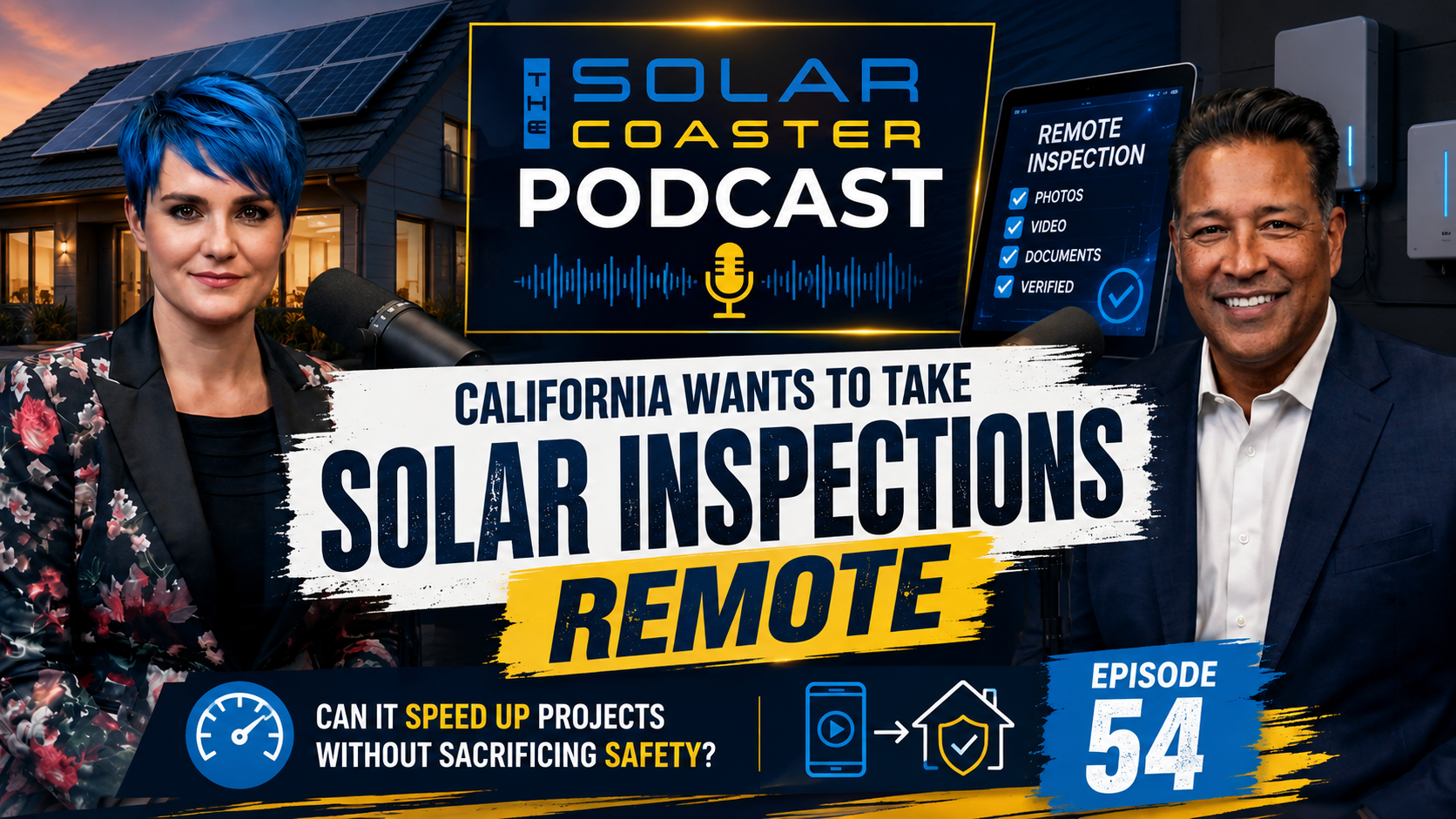
Episode 54 Transcript: California Wants to Take Solar Inspections Remote
In this episode of The Solar Coaster, Anna Covert and Alex Herrera discuss California's move toward remote inspections for residential solar, battery storage, heat pumps, and other home-energy equipment—and whether faster approvals can be achieved without compromising safety and accountability.
Anna Covert: Today we’re looking at a California bill that, according to the headline, would enable remote inspection for residential solar batteries, heat pumps, and related home energy equipment. Even with just that framing, the policy idea is easy to understand: make it simpler and faster to verify installations without always sending someone physically to the site. That sounds like a small administrative change, but in practice it could affect how quickly homeowners get projects approved, how much contractors spend waiting around, and how easily cleaner technologies spread. The big question is whether remote inspection is a smart modernization or a shortcut that risks safety and quality.
Alex Herrera: And I think that tension is exactly why this topic is interesting. On one side, if you are a homeowner who has already invested in a solar battery or a heat pump, the last thing you want is a long delay just because a local office is backlogged. On the other side, when we talk about electrical and mechanical systems in homes, people naturally want confidence that the work was done correctly. So the headline raises a very basic policy tradeoff: convenience and speed versus the reassurance that comes from an in-person inspection. The hard part is that both sides have a valid argument.
Anna Covert: Let’s start with the upside. Remote inspection could reduce friction in a system that often slows down even good projects. If an inspector can review photos, video, documents, and maybe live walkthroughs instead of driving across town, that could save time for local governments and for installers. It might also help in areas where staffing is thin or schedules are overloaded. And from a climate perspective, anything that reduces the soft costs and delays around home electrification could make it easier for more people to adopt clean technologies. That is not a trivial benefit.
Alex Herrera: Right, and there’s also a fairness argument. Not every household or contractor experiences permitting the same way. In some places, the process is smooth and fast. In others, it can feel like every minor step adds another week. Remote inspection could make the process more consistent if it is designed well. A homeowner with a straightforward installation should not necessarily have to wait because the system is optimized for the most complicated case. So in theory, this kind of policy can improve throughput without lowering standards, which is why many people in the industry would probably welcome it.
Anna Covert: But the phrase “if it is designed well” is doing a lot of work there. My concern is that remote inspection can create a false sense of completeness. A photo can show one angle and not another. A video call can miss subtle details. Some issues only become obvious when an inspector is on-site and can physically check clearances, wiring paths, labeling, access, or how equipment interacts with the rest of the home. If the bill’s promise is simply to replace physical inspection with digital review in every case, that would raise real questions about whether the inspection is still doing its job.
Alex Herrera: That’s fair, but I would push back on the assumption that remote means sloppy. Plenty of systems use remote verification successfully when the scope is narrow and the checklist is precise. If the installation type is standardized enough, remote review may catch what matters most. The key is not to imagine remote inspection as a one-size-fits-all replacement. It could be a triage tool: simple jobs get remote review, complex or unusual ones still get an on-site visit. In that model, the policy could preserve safety while reserving human time for the cases that really need it.
Anna Covert: That triage idea is probably the most defensible version of the concept. But it depends on rules that are clear enough to be used consistently. Otherwise, you get confusion: one jurisdiction approves remotely, another refuses, one inspector wants a live walkthrough, another wants twelve photos from twelve angles. Contractors hate unpredictability, and homeowners hate it too. If California is trying to make home electrification easier, then consistency across local offices could matter as much as the inspection method itself. A policy can look progressive on paper and still frustrate everyone if implementation is uneven.
Alex Herrera: And implementation is where the real debate usually lives. Remote inspection sounds modern, but local governments need tools, training, and procedures to support it. There have to be standards for what counts as enough evidence, how records are stored, who signs off, and what happens if a problem is discovered later. A lot of policy conversations skip over that part and focus on the headline win. But if you are responsible for code compliance, the details are the whole game. The success of the bill would depend less on the idea than on the workflow behind it.
Anna Covert: Another issue is trust. A homeowner may trust a brand-name installer or a city inspector, but maybe not the idea of a remote process they cannot see. People often like oversight when it feels personal and dislike it when it feels automated. So even if remote inspection is safe and efficient, officials will probably need to explain it carefully. They would need to show that the process still protects consumers, not just speeds up approvals. Otherwise critics might frame it as lowering the bar for the sake of growth.
Alex Herrera: I think that’s where the public-interest case becomes important. If the bill helps approved systems come online faster, that can support energy savings, backup power, and electrification in homes. Solar batteries can help households manage outages or shift energy use. Heat pumps can replace older heating and cooling systems with something more efficient. Those are meaningful benefits, even if the policy is only about inspections. So from a broader view, this is not just an administrative tweak. It can influence whether clean home technologies feel accessible or burdensome.
Anna Covert: Still, we should be careful not to overstate the impact. A remote inspection policy by itself does not guarantee more installations, lower prices, or better outcomes. It removes one bottleneck, which may or may not be the main one. Labor shortages, equipment costs, utility interconnection, financing, and consumer awareness all matter too. That is why I would call this a facilitation policy rather than a transformation policy. It can help at the margins, and margins matter, but it is not a complete solution to the challenges of residential electrification.
Alex Herrera: Agreed, though margins can be bigger than they look. When a process is repeatedly painful, even a modest improvement can change behavior. If contractors know they can get faster approval, they may bid more jobs. If homeowners hear that the inspection step will not stall the project for weeks, they may be more willing to sign a contract. Policy often works through these confidence effects. It is not only the technical speed of the process; it is the perception that the system is usable. A more usable system can unlock demand.
Anna Covert: Let me press on the safety side one more time, though, because that is the strongest counterargument. Residential solar batteries and heat pumps involve equipment that interacts with electrical systems, building structure, and in some cases fire safety considerations. The public expects that there is a qualified person verifying that installations meet code. If remote inspection becomes the default without enough guardrails, any serious incident could quickly erode trust in the entire approach. So the safest political route would be to make remote inspection obviously limited, transparent, and reversible when needed.
Alex Herrera: That’s a good point, and it suggests the policy should probably be judged by its safeguards, not just its ambition. For example, remote inspection could require submitted evidence from certified installers, standardized checklists, clear documentation, and an easy path to escalate to an on-site inspection if anything is uncertain. That would make the process more like a controlled filter than a blind substitute. In that sense, the bill could be less about taking inspectors out of the picture and more about using their time more strategically.
Anna Covert: And if we look at the politics of it, this kind of bill can appeal to different groups for different reasons. Industry likes efficiency. Homeowners like speed. Local agencies may like the possibility of handling more cases with limited staff. Environmental advocates may like anything that smooths the path for cleaner home energy systems. The challenge is that all those groups can still disagree on how much oversight is enough. So even when there is broad support for the goal, there can be intense debate over the mechanism.
Alex Herrera: That is why I think remote inspection policies often become test cases for a larger question: how much of permitting and compliance can be digitized without losing accountability? We see that question everywhere now. People want government to be faster, but they also want government to be careful. California, based on the headline here, seems to be moving toward a model that tries to do both. Whether that model works will depend on execution, not slogans. If it is thoughtful, it could be a useful template. If it is rushed, it could become a cautionary tale.
Anna Covert: So my bottom line is cautious optimism. The idea of remote inspection for residential solar batteries, heat pumps, and similar systems makes sense as a way to reduce delays and improve access, but only if the state keeps strong standards and uses remote review selectively. I would not want to hear that physical inspection is being abandoned across the board. I would want to hear that California is modernizing a bottleneck without weakening the underlying code enforcement structure. That distinction matters a lot, even if it sounds bureaucratic.
Alex Herrera: And my bottom line is a little more enthusiastic, but still conditional. I think this kind of policy could be a practical step toward making home clean-energy upgrades less cumbersome. The headline suggests a move toward flexibility, and flexibility is often what these systems need. But the real test will be whether the process remains trustworthy, consistent, and easy to understand. If it does, then remote inspection could be one of those unglamorous reforms that quietly makes a big difference.