
For years, renewable energy has been framed as an environmental decision.
Solar meant sustainability.
Wind meant climate action.
Batteries meant resilience.
But that framing is now too small.
In reality, the global energy transition is becoming one of the largest national security shifts in modern history.
Solar is no longer just about being green.
It is about sovereignty.
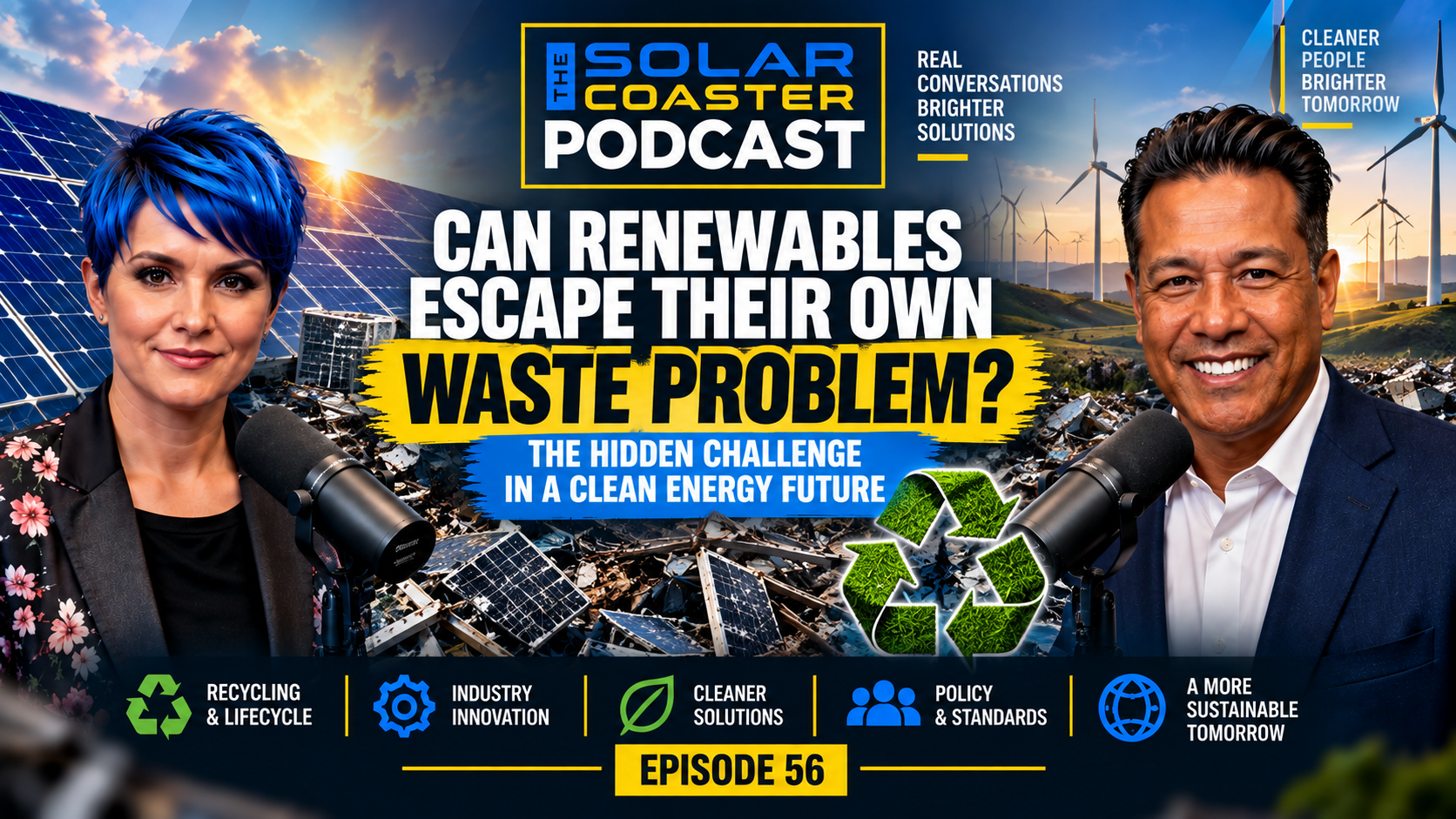
In this episode of The Solar Coaster, we explore the rise of what many are now calling the “Electrotech Revolution”—the transition from centralized fossil fuel dependency to decentralized, electrified energy systems powered by solar, storage, batteries, and intelligent grid infrastructure.
And the implications are massive.
The End of Energy Dependence
For most of modern history, global power has been shaped by geography.
Countries with oil controlled leverage.
Countries without it depended on imports.
Wars were fought over pipelines, shipping lanes, and resource access.
Entire economies were built around fossil fuel dependency.
But renewable energy changes that equation.
Because almost every country on Earth has access to sun, wind, or water.
That means energy independence is no longer a geological lottery.
It becomes an infrastructure challenge.
Who can build it fastest?
Why Solar Is Now a Strategic Asset
A solar panel is no longer just a utility upgrade.
It is a form of protection.
Every rooftop solar system, every battery wall, every upgraded transmission line reduces dependence on imported fuels and volatile global markets.
It lowers vulnerability.
It creates resilience.
It shifts control back to local economies.
That’s why governments are increasingly talking about “homegrown energy,” “energy independence,” and “de-risking supply chains.”
These are not just climate terms.
They are defense terms.
The Economics Have Flipped
There is also a myth that renewable energy is still a luxury.
It isn’t.
The economics have fundamentally changed.
Most new utility-scale renewable projects now generate electricity cheaper than fossil fuel alternatives.
Solar is often significantly cheaper.
Wind is even more competitive in many regions.
Renewables are no longer the moral choice.
They are the financially rational choice.
And when cheaper energy also creates stronger national security, the logic becomes nearly impossible to ignore.
The Real Bottleneck: Bureaucracy
The technology exists.
The funding exists.
The demand exists.
So why aren’t we moving faster?
Because the problem is no longer innovation.
It is execution.
There are currently enormous amounts of renewable generation capacity stuck in global grid interconnection queues.
Projects are ready.
But permitting delays, outdated infrastructure, and administrative bottlenecks are slowing deployment.
The traffic jam is political, not technical.
The Future of Conflict
Perhaps the most profound implication is geopolitical.
If nations become energy self-sufficient, what happens to the traditional drivers of conflict?
What happens when countries no longer need to invade neighbors for oil, protect chokepoints for gas, or rely on unstable foreign supply chains?
What happens when power becomes local?
The promise of Electrotech is bigger than energy.
It is the possibility of reducing one of the oldest causes of war itself.
Final Thought
We are not just rewiring the electrical grid.
We are rewiring the structure of global power.
From extraction to generation.
From dependence to sovereignty.
From vulnerability to resilience.
The future of energy is not just cleaner.
It is safer.
And that changes everything.
Full Podcast Transcript:
The Solar Coaster Podcast Transcript
Electrotech Revolution — Why Clean Energy Is the New National Security Strategy
Anna Covert: I love that bamboo analogy. It paints a picture of resilience. But let's look at the political reality of this. When I read about massive government initiatives—like the Inflation Reduction Act in the US or the Green Deal Industrial Plan in Europe—they are always packaged as climate policies. But listening to you, it sounds like they are actually stealthy defense budgets.
Alex Herrera: Spot on. That is exactly what they are. If you read between the lines, policymakers are now using terms like "homegrown energy," "de-risking supply chains," and "energy independence." These policies were engineered to onshore manufacturing and shield domestic economies from the wild, unpredictable swings of global fuel markets. Every new solar array in a desert, every offshore wind farm, every heat pump installed in a suburban basement, and every electric vehicle rolling off an assembly line—these are no longer just green initiatives. They are strategic, hard assets.
Anna Covert: So, a solar panel isn't just a power source anymore. It is quite literally a shield.
Alex Herrera: Exactly. They insulate a country from external fuel shocks, dampen price volatility, and build compounding economic value entirely within their own borders.
Anna Covert: But let me play devil's advocate for a moment, because the scale of what you are talking about is staggering. Transitioning an entire global economy sounds incredibly expensive. If governments are already battling inflation, dealing with trade deficits, and facing tight budgets, how can they afford to just unplug the old, centralized system and wire up a brand new one?
Alex Herrera: That is the great myth that the current data is completely shattering. The numbers have flipped, and the markets are responding aggressively. This isn't about altruism anymore; it is cold, hard, ruthless economic calculation.
Anna Covert: Wait, so the math actually favors the transition now? It's not just subsidized wishful thinking?
Alex Herrera: Far from it. Last year alone, renewables helped avoid nearly half a trillion dollars in fossil fuel costs globally. Over ninety percent of new utility-scale renewable projects now deliver power cheaper than the lowest-cost fossil fuel alternative. Solar power is averaging over forty percent cheaper, and onshore wind is over fifty percent cheaper.
Anna Covert: That completely rewrites the narrative. It's no longer a financial sacrifice to go green; it's actually a severe economic penalty if you don't.
Alex Herrera: Absolutely. And the employment data is staggering. Investing in renewables creates roughly three times more jobs per dollar invested than fossil fuels. Governments are suddenly freed up to invest in education, healthcare, and next-generation infrastructure instead of constantly subsidizing imported fuel dependence.
Anna Covert: Which brings up a fascinating angle—the Global South. Because if this logic applies to wealthy, industrialized nations, it must be absolutely life-changing for developing economies.
Alex Herrera: It is a matter of survival and sovereignty for them. Almost every nation on Earth has enough sun, wind, or water to become entirely energy self-sufficient. It is no longer a geopolitical lottery of who happens to have oil beneath their sand. It becomes an infrastructure challenge of who can build the tools to capture the sun and wind above it.
Anna Covert: Okay, I am completely sold on the vision. The economics work, the security aspect is undeniable, and the technology exists. But let's talk reality. Just slapping a million solar panels onto an electrical grid designed in the nineteen-fifties isn't going to magically solve everything.
Alex Herrera: Exactly. That is where we need to introduce a vital concept: Electrotech. People constantly mistake the energy transition as simply building more renewables. But Electrotech is much broader. It encompasses electrified demand, massive battery storage, smart grids, flexibility, and digital controls, all operating as a single coherent ecosystem.
Anna Covert: So, if the solar panels and wind turbines are the muscles generating the power, Electrotech is the nervous system and the brain making sure the body actually functions.
Alex Herrera: Precisely. And deploying this Electrotech ecosystem is how you eliminate catastrophic single points of failure. A diversified system supported by utility-scale storage, rooftop solar, and smart cross-border interconnectors creates an incredible web of redundancy.
Anna Covert: But here is the million-dollar question. If the Electrotech is proven, if the economics are a no-brainer, and if the security benefits are this profound… why aren't we moving faster?
Alex Herrera: The bottleneck is no longer the technology, and it is no longer the funding. The bottleneck is the delivery. It is the bureaucracy. Right now, there are over three terawatts of renewable generation capacity literally stuck in global grid connection queues.
Anna Covert: Three terawatts? Put that into perspective for me.
Alex Herrera: The entire electricity generating capacity of the United States is roughly one point two terawatts. So we are talking about nearly three times the entire US power grid just sitting in a bureaucratic waiting room.
Anna Covert: It's a bureaucratic traffic jam of epic proportions. We have the cure for the disease, but we can't seem to get it out of the pharmacy.
Alex Herrera: Exactly. Ambition without execution is just an illusion. Governments and corporations have formed massive coalitions, announced net-zero targets, and made grand promises. But we have to pivot aggressively from promises to hard deployment milestones.
Anna Covert: So how do we clear the traffic jam? What is the actual boots-on-the-ground action plan?
Alex Herrera: There are five absolute priorities. First, permitting has to be fast-tracked. Second, we must expand and modernize the physical grid networks. Third, we need to mobilize finance at unprecedented scale. Fourth, we need massive electrification across transportation, industry, and heating backed by battery storage. And fifth, we must scale the physical supply chains and workforce in parallel.
Anna Covert: It feels like we are standing on the precipice of a completely new era of human history.
Alex Herrera: We are. We spent the twentieth century fighting over what was buried underground. Now, we are finally looking up. We are looking at the sun, the wind, the water.
Anna Covert: If every nation eventually achieves this—if countries become energy islands—what happens to global conflict?
Alex Herrera: That is the breathtaking promise of the Electrotech revolution. It is not just about keeping the lights on. It is about removing one of the oldest catalysts for human conflict. When energy belongs to everyone and can be harvested in your own backyard, power shifts back to the people.
Anna Covert: We are not just rewiring the electrical grid; we are rewiring the future of human history.
Alex Herrera: Exactly. The clock is ticking. The technology is waiting, the capital is ready, and the stakes have never been higher. The only thing left is for us to get out of our own way and actually build it.
Anna Covert: A race against our own bureaucracy to build a safer world. Let's hope we have the courage to win it. Thank you all for tuning in.